What the Marsh Keeps
Where memory settles after the tide recedes.

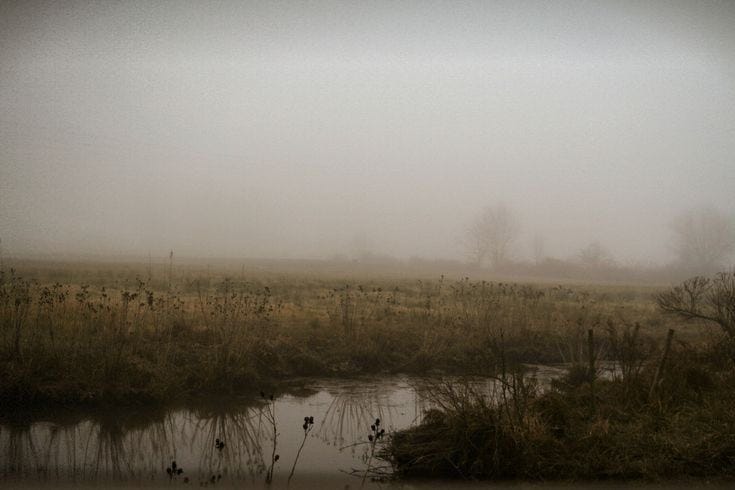
There is something unsettling about a marsh that photographs can never quite capture.
Not because it is dark.
Most days it isn’t.
The marsh glows in the afternoon light. Herons stand motionless in the shallows. The wind combs through the spartina grass until the entire landscape seems to breathe as one living thing.
It is beautiful.
But beauty has a way of making us forget that a place can also be dangerous.
The marsh does not announce itself like the ocean.
The sea crashes.
The marsh whispers.
It waits.
It changes so slowly that you don’t notice it happening.
One tide reshapes a creek.
Another buries a footprint.
A storm arrives, and suddenly an island exists where there wasn’t one before. A channel disappears. Trees stand where there used to be open water.
Nothing stays exactly where you remember leaving it.
Perhaps that is why marshes have always felt like places where stories belong.
Not because they are haunted.
Because they refuse to stay still long enough for certainty.
Every generation inherits a slightly different landscape.
And with it, a slightly different story.
I think that is why folklore clings to wetlands.
People tell stories to explain what keeps changing.
One family says someone disappeared here.
Another insists lights dance above the reeds before a hurricane.
Someone else swears the birds know something long before the weather does.
Whether those stories are true almost doesn’t matter.
The stories become another layer of the landscape.
Just as real as the mud beneath your boots.
Storms have a peculiar relationship with memory.
Afterward, people don’t only count what was destroyed.
They count what cannot be found.
Photographs.
Homes.
Roads.
Trees that had stood for generations.
Entire versions of a place disappear overnight.
The map changes.
So does memory.
You begin saying things like,
“There used to be a dock there.”
“That road didn’t flood before Florence.”
“The marsh looked different when I was a child.”
Places remember disasters in ways people cannot.
The land carries them forward.
I think that is why I keep writing about marshes.
Not because they are frightening.
Because they remind me that memory isn’t fixed.
It shifts.
It erodes.
It returns with the tide.
Sometimes the things we lose are gone forever.
Sometimes they simply wait beneath the surface until the water is low enough to reveal them again.
Perhaps every landscape keeps something.
Mountains keep echoes.
Forests keep silence.
Cities keep names.
But marshes…
Marshes keep stories.
And if you stand still long enough, you begin to wonder whether they have been waiting to tell them all along.
Author’s Note
Living in coastal North Carolina has changed the way I think about landscapes.
The marsh is never quite the same place twice. The tides redraw its edges, storms leave their own signatures, and every season reveals something that wasn’t there before. I’ve spent countless hours walking these places with a camera in one hand and a notebook in the other, wondering how a landscape can feel both familiar and unknowable.
Long before the marsh became the heart of Queen of the Moths, it became one of the places that taught me how stories are born.
Thank you for reading.
🦋
I feel like I’m standing there. That’s something I feel time and time again with your work. It’s so easy to be immersed in your vision.